THE DINNER NOBODY SCHEDULED — PART TWO

The Monday That Didn't Go How They Expected
I had good cases that day.
The kind that remind you why you chose this. Clean, precise, unhurried. Elegant in the way that only happens when the hands and the field and the machine are all moving together — the robot humming underneath, the OR settled into that particular quiet that is not silence but certainty. You finish a day like that and there is a feeling that comes over you that you cannot manufacture. It arrives on its own when the work has been good and you know it. Something closer to clarity than exhaustion.
My playlist was still in my head on the drive home.
The sunset met me somewhere outside of town and did not let go. The kind that melts into a forever horizon in colors that only seem to exist in this part of the country in the middle of summer — amber bleeding into something deeper, the heat still visible in the air, the whole flat landscape gone gold and quiet and impossible to photograph because you already know it won't survive the frame. I watched it through the windshield and thought about the six o'clock call.
Not with dread. Not with anything like anxiety.
More the way you think about a hand you've already decided how to play. Quiet. Settled. Already somewhere ahead of the moment.
I had known what was coming since the dinner.
The only question was how they were going to frame it.
I pulled into the hotel parking lot with four minutes to spare.
Set the laptop on the desk. Opened the Zoom meeting.
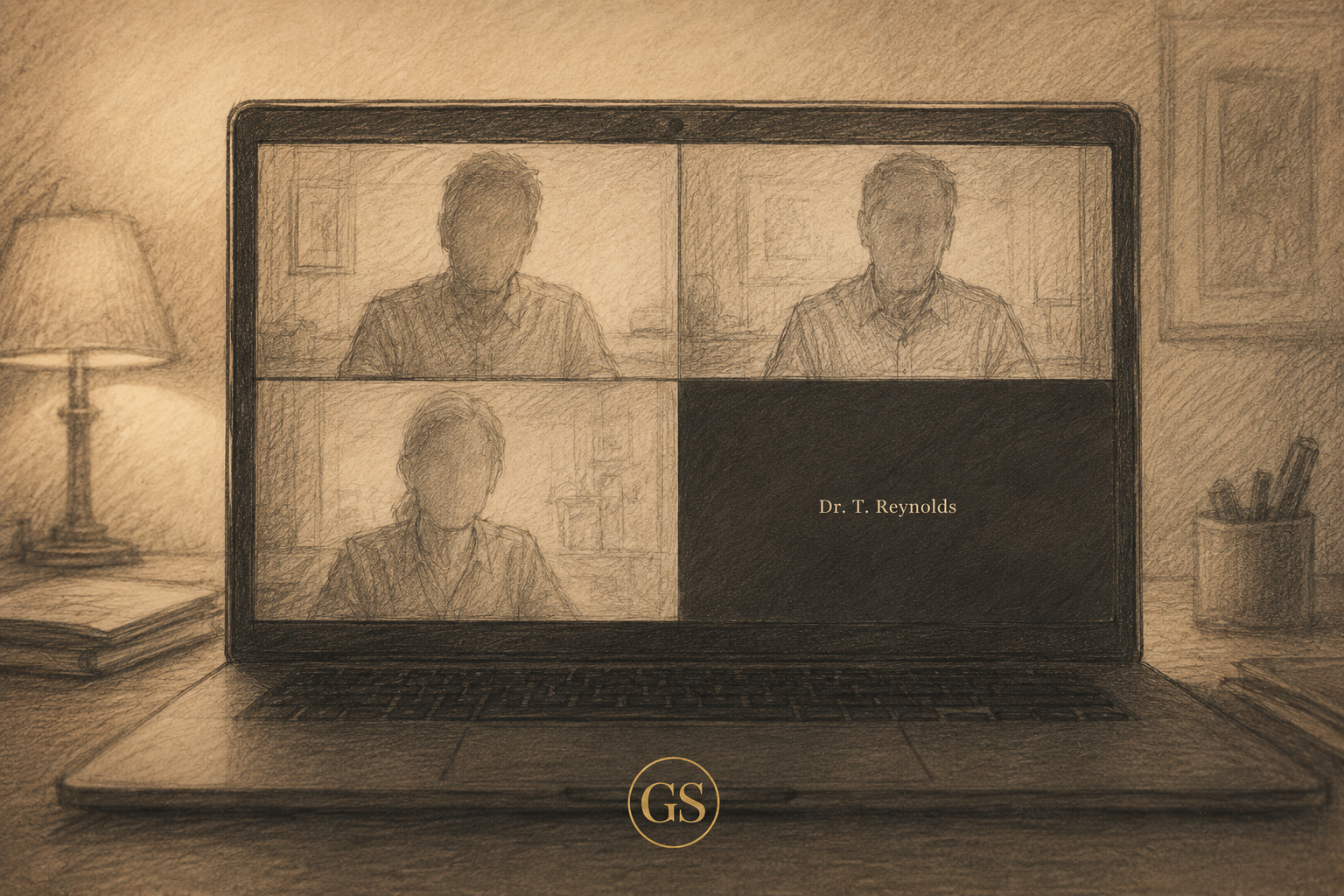
Three faces on the screen. One dark square.
The office manager was there — visible, pleasant, the kind of person who has to be in a room because of her title but carries no authority in it. She was kind. She always had been. I had nothing against her.
The two higher-ups: faces I recognized from maybe one or two prior meetings. Administrators who are good at their jobs precisely because they have learned to deliver difficult news without a register that acknowledges it as difficult. The warmth had been removed. Not because they were cruel. Because warmth creates negotiation, and they were not there to negotiate.
The fourth square: a name I did not recognize. Camera off. Silent the entire call. Someone who just needed to be there. Another higher-up, probably. I was unbothered. I had already decided I did not need to know.
I play poker.
I noticed all of it. I said nothing about any of it. I kept my camera on and let them talk.
They confirmed what I already knew.
Call coverage at the first hospital was being restructured. General surgery — acute care, overnight, the work that actually constitutes emergency surgery — was being pulled. What remained would be elective. Scheduled. The kind of caseload that photographs well in a hospital brochure and does not wake you at two in the morning.
Then they offered me an option.
They could shift my contract to another facility in the system. A Level II trauma center, versus the Level IV I had been covering.
I asked very few questions. I listened to the shape of the offer — where the weight was, where the silence was, what they were not saying. Then I ended the call the way you end a hand you've already decided to play differently. Politely. Without showing anything.
Within the hour I sent an email.
One paragraph. Written the way a surgeon writes a consult note — precise, sequential, without editorializing. I wanted them to read back to themselves what they were actually offering.
So to confirm: you'd like me to discontinue call coverage at Hospital A and assume call coverage at Hospital B — a Level II trauma center — at the same pay rate, the same callback rate, and the same activation rate as the Level IV I've been covering?
I sent it and waited.
A Level IV trauma center and a Level II trauma center do not pay the same. The acuity is different. The call burden is different. The procedural volume is different. The market rate for what they were asking me to do was different — and I knew it, and they were not offering different. They were offering the same contract with a different address.
I wasn't angry about it. I just wanted the arithmetic to be visible. Sometimes the most clarifying thing you can do in a negotiation is refuse to obscure the terms.

They confirmed. Yes. That is what they were proposing.
I asked if there was any room for negotiation.
There was not.
I told them the contract was fine. I told them I would get back to them with availability. The schedule I had previously provided was no longer intact. I dissolved it quietly, in a single sentence, without explanation. In my mind this hospital had just dropped several rungs. It would not be getting my services as frequently as they had assumed. It was time to go hunting again.
I did not tell them any of that. I didn't need to.
That is what the ninety-day clause is. Not a threat. Not leverage you announce. Just architecture — quiet, already built, already yours. You don't brandish it. You use it in a single paragraph, over email, without raising your voice once.
They said they understood.
I closed the laptop. The sunset was gone. The room was dark except for the screen fading out.
The older surgeon did not have the same conversation.
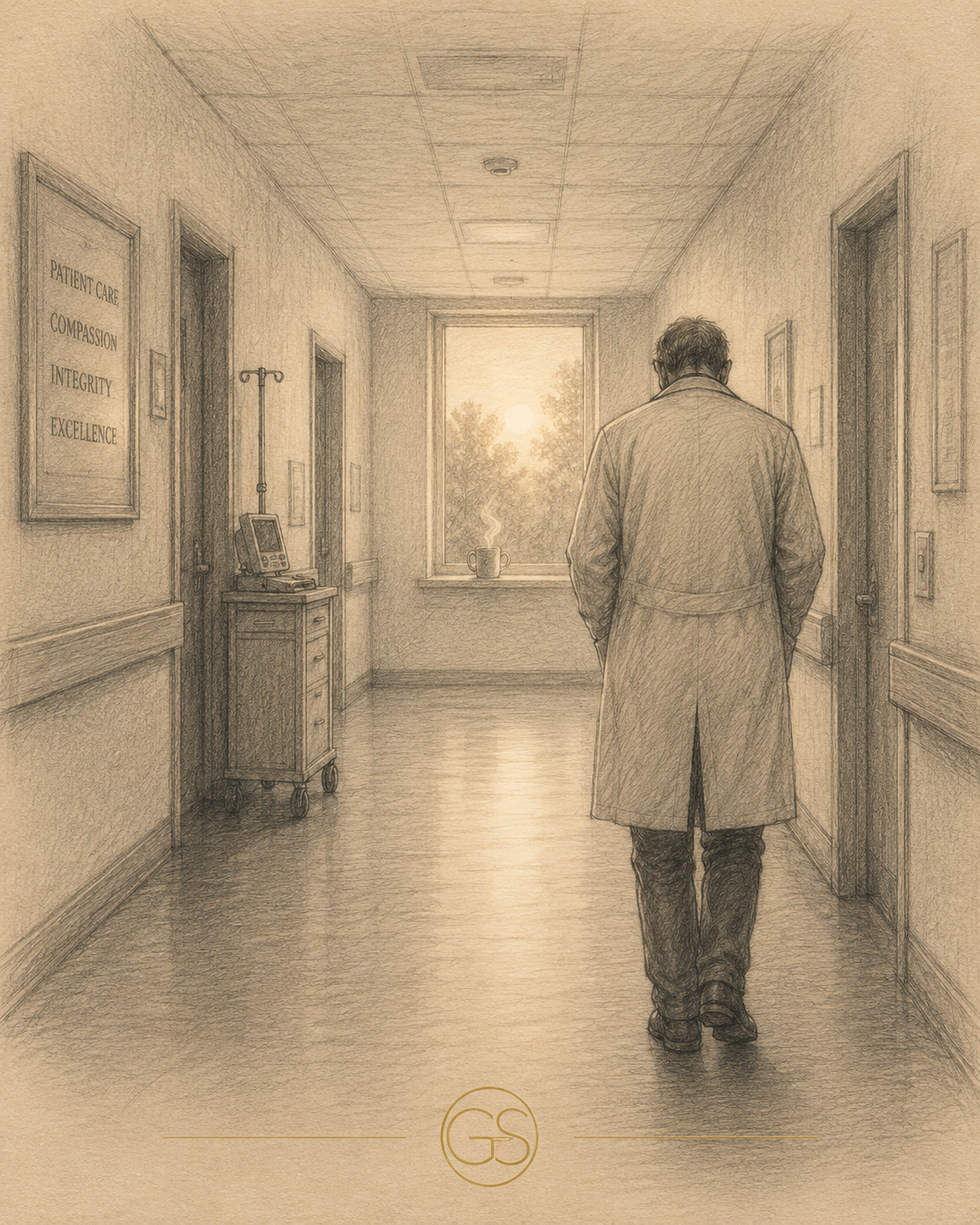
I passed him in the hallway a few days later. The set of the jaw. The particular way a person carries the weight of something already decided and not yet metabolized. The restructuring had moved through his career like weather — quietly, completely, right underneath him before he knew it had arrived. He would take it. He would keep showing up. He would absorb the slow replacement of emergency surgery with scheduled cases because the architecture of his career — one system, one employer, built brick by brick across thirty years — does not have a side door.
The golden box stays buried.
He didn't say this out loud. He wouldn't. Neither would I. But it was there in the way he moved through that corridor — the weight of a man who has already made the decision and is now simply living inside it. You could feel the burden with each step he took. The kind of weight that doesn't show on the surface but changes the way a person occupies space.
I want to be clear: this is not a failure of character. It is a failure of architecture. He built exactly what his generation was told to build — loyalty, tenure, institutional belonging, the slow accumulation of a career inside one place. He did everything right. The institution restructured around him while he was still inside it, and the building he built did not have a side door. Nobody told him to put one in.
That is the grief underneath all of this. Not anger. Not resentment. Grief — for what the system costs people who trusted it completely and were never told there was another way to build.
Twenty-four hours after that email.
I reached out to a higher-up at another hospital system I was already working within. Rural state. Large footprint. The kind of network where needs go unmet simply because nobody thinks to ask. I asked one quiet question.
Are there needs across the system — outside of where I'm already working — that haven't been filled?
There was a huge need.
Within forty-eight hours, two people contacted me. Separately. Higher-ups. They wanted to talk. I talked to both of them.
I now have more options than I had before the meeting.
Sit with that for a moment.
The hospital restructured. The work disappeared. A surgeon with thirty years in that system is absorbing a reality he didn't choose, in a corridor he can't leave. And I walked out of the same meeting with more options than I walked in with.
Same news. Same room. Two completely different outcomes.
Not because I worked harder. Not because I out-negotiated anyone. Because one of us had built the infrastructure for optionality before the moment required it. When the node underperformed, I could reorder. Not as a crisis. As a Tuesday morning decision.
The IPM is not a philosophy. It is not a mindset. It is a structural arrangement — one that means you are never ambushed because you are never dependent on a single outcome. The original hospital is still on my list. Still credentialed. Still on staff. If they have work and I have availability and the terms make sense, I'll take a shift. The relationship didn't end — it changed in priority. There is no drama in that. There is only the calm of a system working exactly the way it was designed to.
That is the entire difference between a captive and a sovereign. The captive cannot reprioritize. The sovereign never needed to leave.
Part Three is already in motion.
What do you do with new options? When one door drops in priority and two others open in the same week — how do you navigate that? How do you build from a moment that looked, from the outside, like a setback?
That is where we are going.
Stay tuned.
Work optional. Life intentional.
— Golden Scalpel

Nothing here is financial, legal, or medical advice. Golden Scalpel is an independent media publication. Always consult a qualified professional before making major decisions. This is perspective, not prescription.