
Data Center: The Physician Desert — the data behind Rural America Needs Surgeons

Sunday's piece left you at a lake on a Tuesday afternoon in August, the only surgeon within 80 miles. This is the proof that the lake exists — and why it keeps getting harder to find someone willing to drive to it.
The United States is not running out of physicians. It is running out of physicians willing to practice where patients actually are.
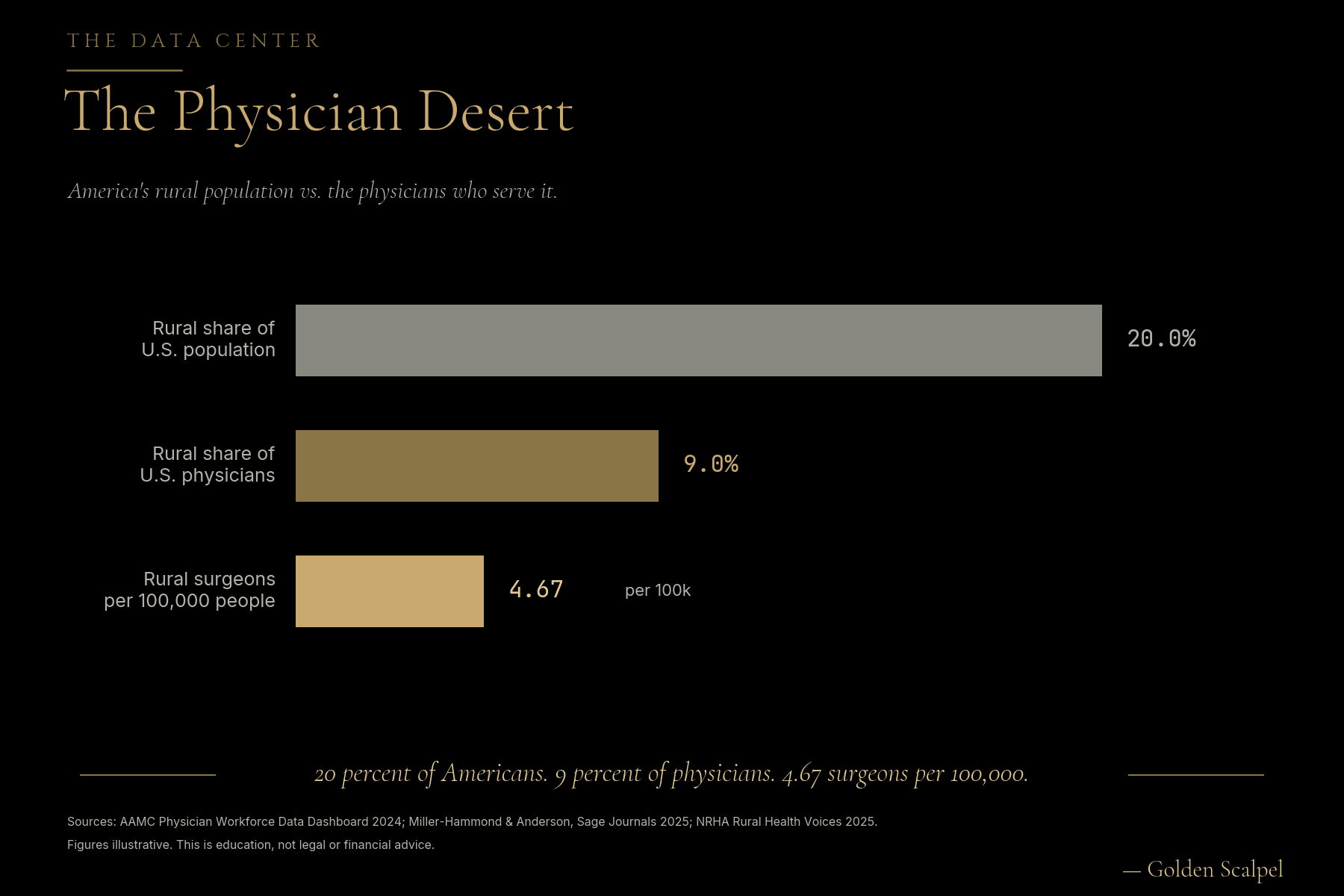
Roughly 20 percent of Americans live in rural areas. Nine percent of the nation's physicians practice there. For surgeons specifically, the number is 4.67 per 100,000 rural residents. Read that twice.
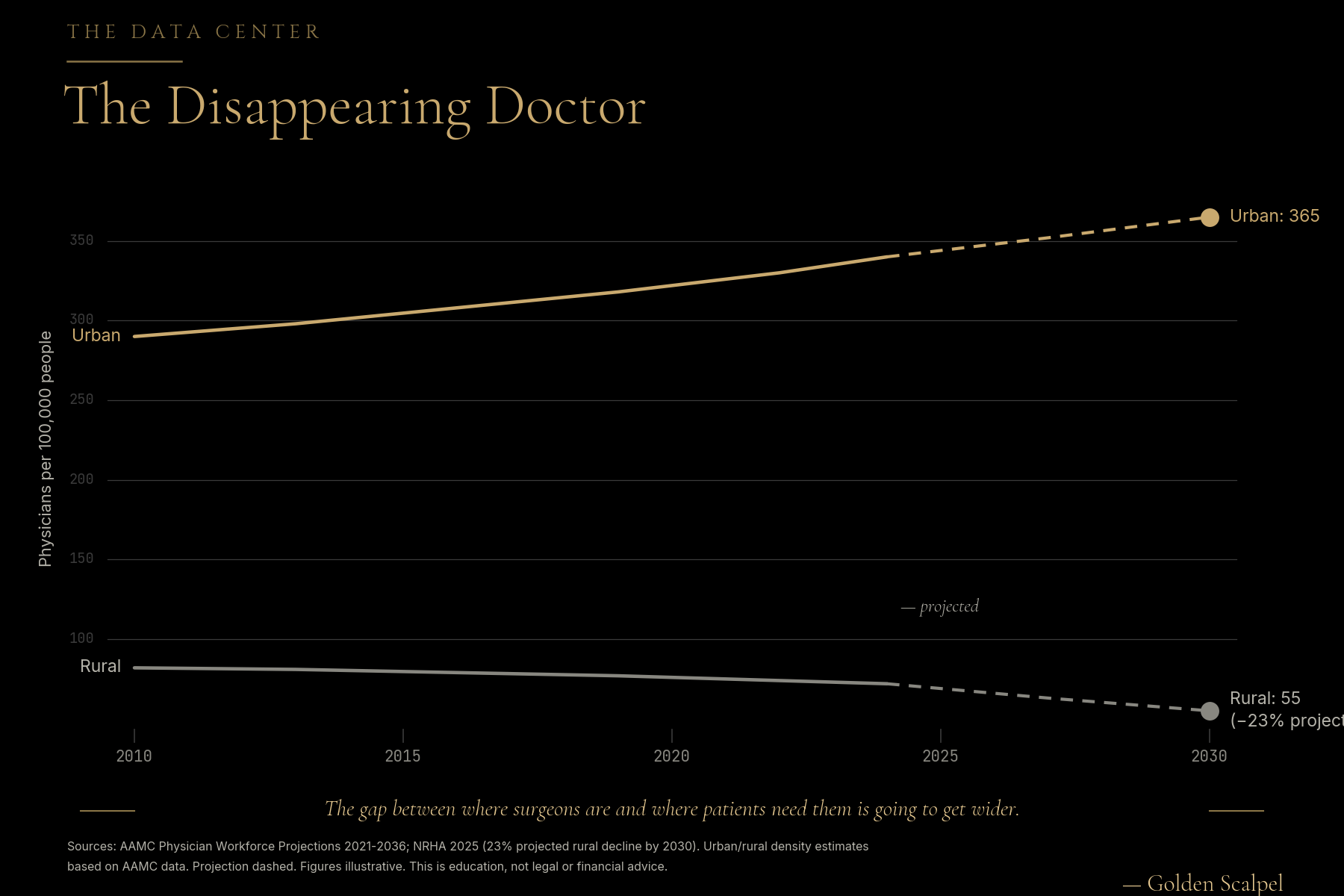
That ratio is not new. What is new is the trajectory. With more than half of rural physicians currently over the age of 50, the NRHA projects a 23 percent decline in rural physicians by 2030. The physicians who remain are aging out. The pipeline is not replacing them at the rate required. The gap between where surgeons practice and where patients need them is going to get wider before it gets narrower.
The map below shows where the shortage is by state — specifically, what percentage of each state's primary care needs are currently being met, and how many additional physicians would be needed to close the gap. Click any state.
The national average is 48 percent of primary care needs met. Fewer than half. In the hardest-hit states — Alaska at 27 percent, Oklahoma at 31, Maryland at 29 — the gap is not a policy problem awaiting a solution. It is a structural reality that will persist for years regardless of what happens in Washington.
The physician who can function anywhere — who walks the OR on day one, who does not need the comfort of familiar systems to do excellent work — is not just managing their own career. They are practicing in the only place the math actually needs them.
That is not a small thing.
References & methodology
- National Rural Health Association, Rural Health Voices Blog, 2025 — ruralhealth.us. Rural physician share (~9%) and projected 23% decline by 2030.
- Miller-Hammond K, Anderson D. Barriers to Surgical Health Care Access in Rural Communities. Sage Journals, 2025. Rural surgeon density: 4.67 per 100,000.
- AAMC Physician Workforce Data Dashboard, 2024. Physician distribution urban vs. rural.
- HRSA Bureau of Health Workforce, Designated HPSA Statistics, December 31, 2025 (via Becker's Hospital Review, January 2026). State-level % of primary care need met and practitioners needed to remove HPSA designation.
- HRSA State of the U.S. Health Care Workforce, 2024. 58 million Americans in HPSA-designated areas.
Every figure illustrative. This is education, not legal or financial advice.
THE VAULT holds 12 tools for paid subscribers.
Built for residents who are about to make decisions that will follow them for a decade — and for attendings who wish someone had given them this at the start
FREE TOOLS
Four tools. No email. No catch. Run your numbers and keep them.
Built by a surgeon who wished these existed during training.
The W-2 True Cost Calculator

What is the real cost of an employed physician contract?
Most residents sign their first attending offer without running this number. Most attendings wish they had. Enter a salary, the hours, the weeks. The tool shows what that arrangement is actually worth — and what it costs you that the contract never mentions.
Run it on any offer before you sign it.
The Work Optional Timeline Calculator

The year work becomes optional is not fixed. It is a variable — and you control it.
Most residents never think about this number until they are ten years into an arrangement that was never designed to give it to them. Enter what you will earn, what you will save, what you will spend. The tool returns one number.
The earlier you run it, the more it changes.
The Five Dials Diagnostic

Five dimensions. Twenty questions. One archetype.
For attendings: know where you actually stand before you decide where to go.
For residents: know where you want to go before someone else decides for you.
Most physicians discover their Five Dials score after signing a contract that scores them a zero on autonomy. This takes four minutes. Run it before the offers come.
FREE REFERENCE
The IPM Glossary

21 terms physicians need to know — contract language, business vocabulary, the framework. One page. Built because nobody handed us this at the start.
Work optional. Life intentional.
— Golden Scalpel