
Data Center: The decisions you never made — the data behind The Dinner Nobody Planned

Sunday's piece left you at the table, looking around, realizing you never ordered any of it. The courses arrived anyway. This is the proof.
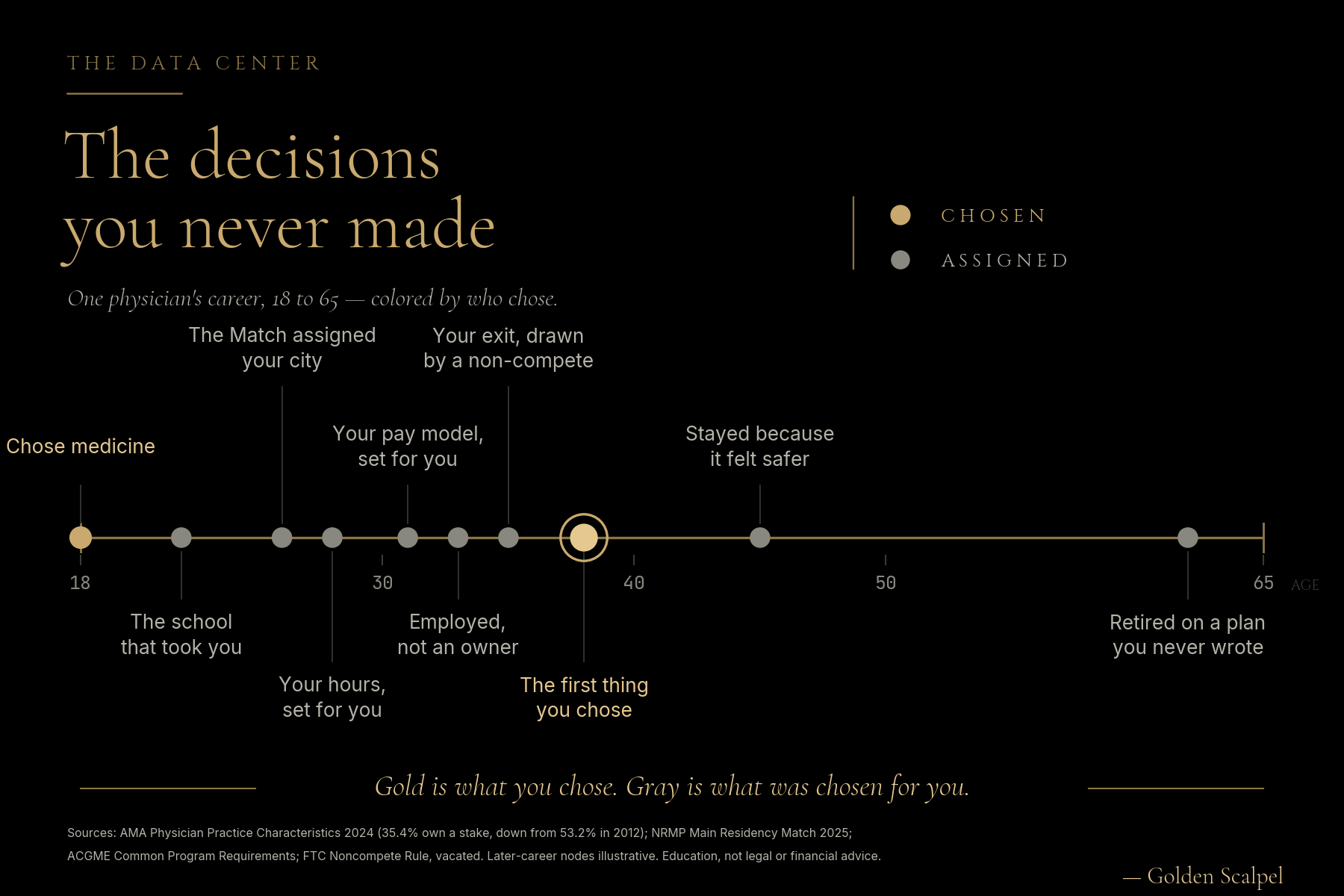
Map one physician's career from eighteen to sixty-five and color each decision by who actually made it. Gold for the choices made with full agency. Gray for the choices made by an algorithm, a requirement, a contract, a default.
The first half of the timeline is almost entirely gray.
The Match assigned the city — you submitted a rank list, but the algorithm produced the binding placement, not you. The duty-hour standard set the schedule. The first contract handed over a compensation model built before you walked in. And the ownership number is the one that should stop you: in 2024, only 35.4 percent of physicians held an ownership stake in their practice, down from 53.2 percent in 2012. Nearly two-thirds of physicians no longer own the thing they spend their lives inside. The youngest cohort owns the least.
Then the non-compete drew the geography of your exit — and the federal rule that briefly promised to void it never took effect, leaving the clause governed by whatever state you happen to be standing in.
That is the dinner nobody planned. Not a conspiracy. Just institutional momentum, arriving course by course, with the full force of inevitability.
But the timeline is not destiny. It is a sequence of decision points, and most of them are still open longer than anyone tells you. Here is the same career, decided differently — the physician who started asking what they wanted in year three of residency.
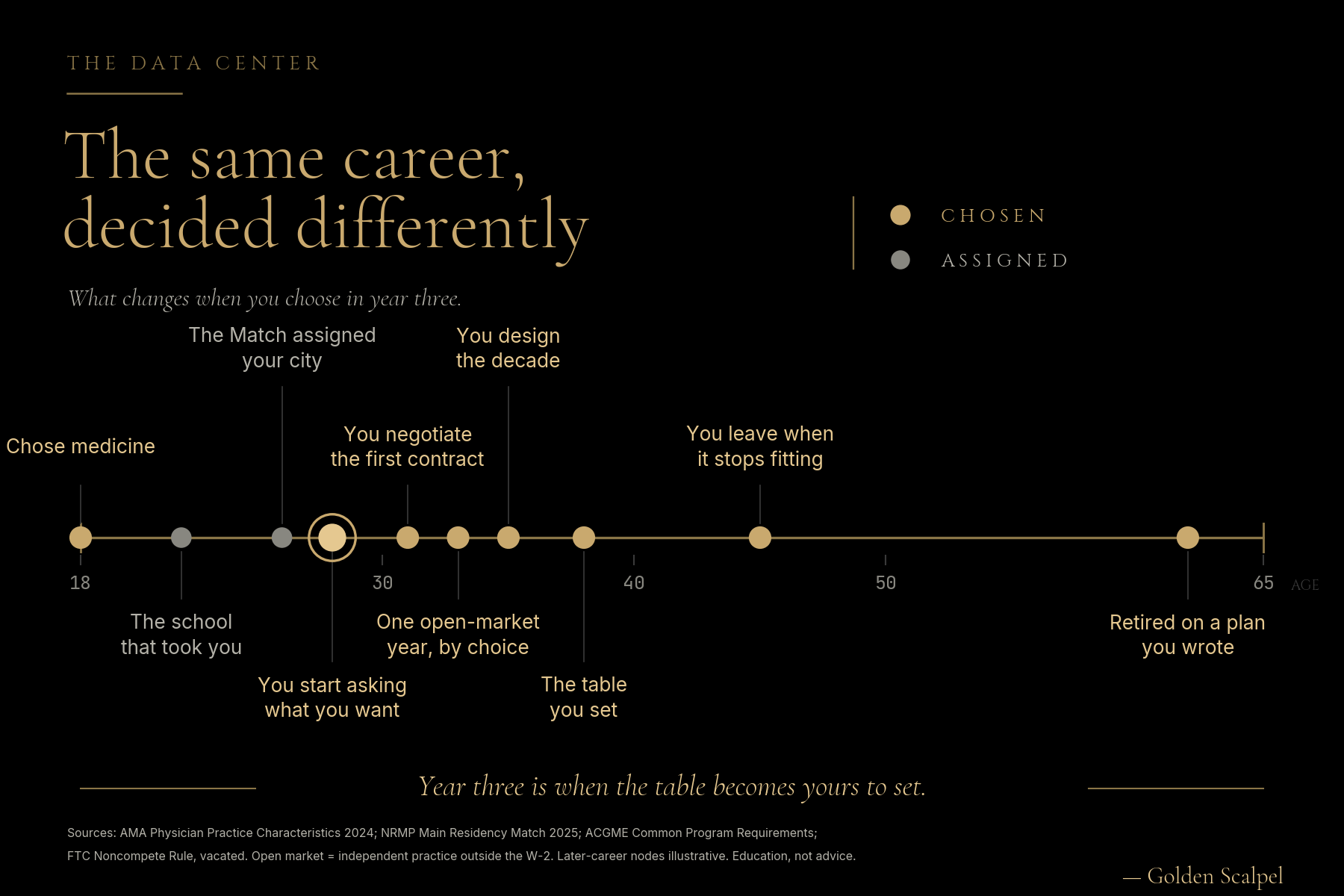
The Match still assigned the city. The school still chose itself. Those nodes stay gray; you cannot rewrite them. But everything after year three turns gold. The first contract gets negotiated instead of signed. One open-market year tests the assumptions before a decade gets committed to them. The exit is designed, not discovered.
Same person. Same starting gray. One different decision in year three, and the second half of the plate is something they actually ordered.
The dinner gets planned either way. The only question is whether there is a guest at the table who knows what they want — and that guest can send courses back.
References & methodology
American Medical Association, Physician Practice Characteristics in 2024 (Carol K. Kane, PhD; 2024 Physician Practice Benchmark Survey, fielded Aug–Sept 2024, n=5,000). Ownership stake 35.4% in 2024 vs 53.2% in 2012; private practice 42.2% vs 60.1% in 2012.
National Resident Matching Program, Results and Data: 2025 Main Residency Match. 52,498 registered applicants; placement determined by the matching algorithm from submitted rank order lists.
Accreditation Council for Graduate Medical Education, Common Program Requirements (clinical and educational work-hour standards).
Federal Trade Commission, Noncompete Rule. Vacated and not in effect (Ryan LLC v. FTC, Aug 2024; FTC appeal dismissed Sept 2025; rule removed from federal regulations 2026). Enforceability now governed by state law.
THE VAULT holds 12 tools for paid subscribers.
Built for residents who are about to make decisions that will follow them for a decade — and for attendings who wish someone had given them this at the start
FREE TOOLS
Four tools. No email. No catch. Run your numbers and keep them.
Built by a surgeon who wished these existed during training.
The W-2 True Cost Calculator

What is the real cost of an employed physician contract?
Most residents sign their first attending offer without running this number. Most attendings wish they had. Enter a salary, the hours, the weeks. The tool shows what that arrangement is actually worth — and what it costs you that the contract never mentions.
Run it on any offer before you sign it.
The Work Optional Timeline Calculator

The year work becomes optional is not fixed. It is a variable — and you control it.
Most residents never think about this number until they are ten years into an arrangement that was never designed to give it to them. Enter what you will earn, what you will save, what you will spend. The tool returns one number.
The earlier you run it, the more it changes.
The Five Dials Diagnostic

Five dimensions. Twenty questions. One archetype.
For attendings: know where you actually stand before you decide where to go.
For residents: know where you want to go before someone else decides for you.
Most physicians discover their Five Dials score after signing a contract that scores them a zero on autonomy. This takes four minutes. Run it before the offers come.
FREE REFERENCE
The IPM Glossary

21 terms physicians need to know — contract language, business vocabulary, the framework. One page. Built because nobody handed us this at the start.
Work optional. Life intentional.
— Golden Scalpel

Nothing here is financial, legal, or medical advice. Golden Scalpel is an independent media publication. Always consult a qualified professional before making major decisions. This is perspective, not prescription.