
Resident Corner: Add It Up — The True Cost of What You Signed Up For

You are three months into your first attending job. The offer letter said one number. Your bank account is saying another. And somewhere in a drawer is a contract you signed in a single afternoon, between cases, because the recruiter needed it back by Friday.
On Sunday I wrote that the contract is the most expensive thing you will ever sign as a physician. Here is the part nobody shows you: the expense is back-loaded. You do not pay when you sign. You pay when you leave. And by then the price is fixed.
So let's add it up.
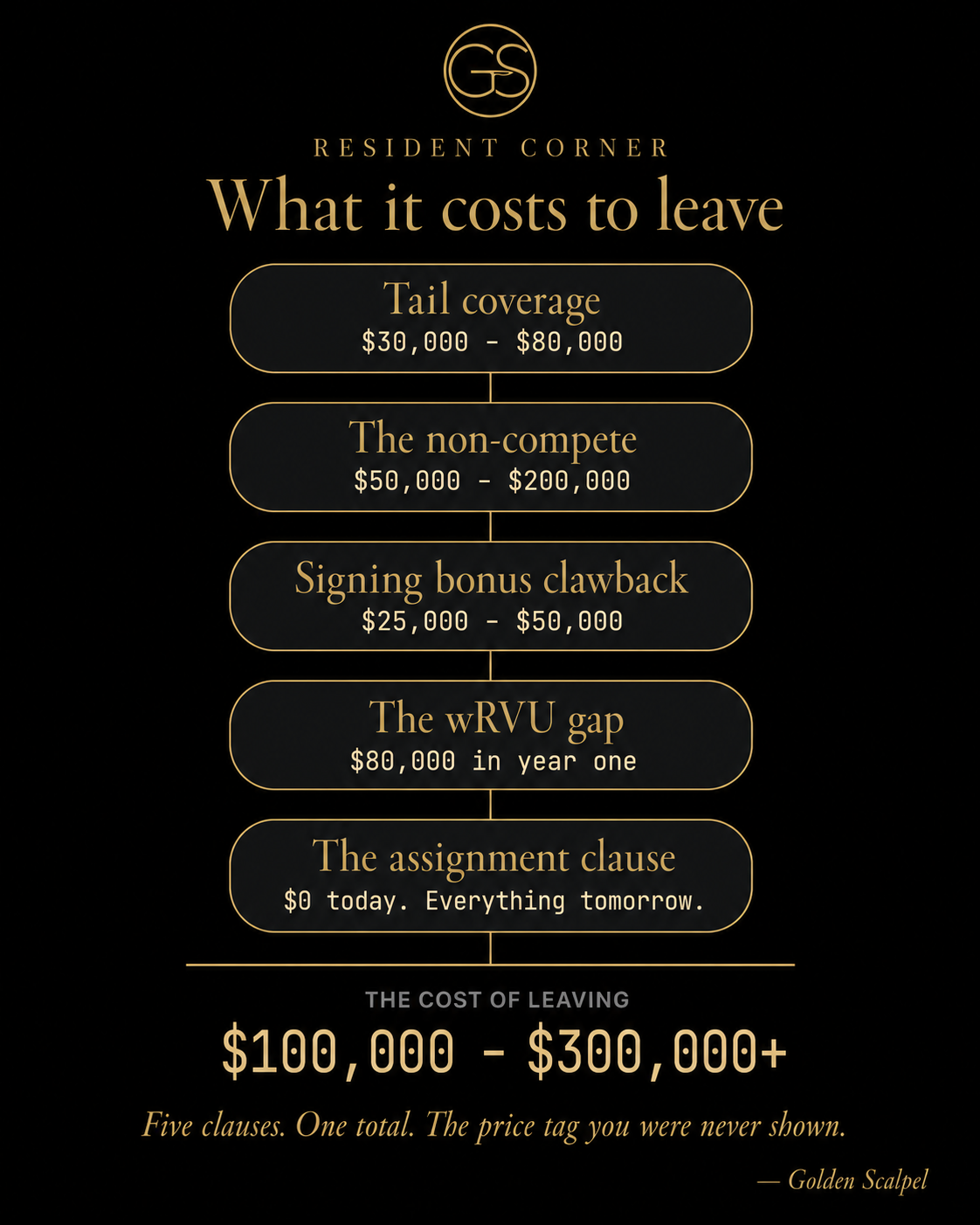
Tail coverage
If your malpractice policy is claims-made, it only covers claims filed while you are employed. The day you leave, that coverage stops — even for cases that happened on your watch. To stay protected, you buy a tail, and a tail runs 150 to 300 percent of your annual premium. For most physicians that is $30,000 to $80,000. The only question that matters: who pays it, you or them? Find that line before anything else.
The non-compete
If it is enforceable in your state, leaving means one of two things — relocate your entire life, or stop practicing your specialty inside the radius for one to three years. Relocation plus a few months of interrupted income lands between $50,000 and $200,000, fast. (The non-solicitation clause sitting next to it is quieter and just as costly: it can stop you from bringing your staff or telling your patients where you went.) Know your state's law before you sign, because the same clause is void in California and ironclad two states over.
The signing bonus clawback
That bonus felt like a gift. It was a loan with a time lock. Leave before the vesting date and you repay it — typically $25,000 to $50,000, sometimes prorated, sometimes not. Read the clawback schedule. The date it ends is the date you are actually free to go.
The wRVU gap
If your pay is productivity-based, the offer letter showed you a target, not a guarantee. In year one, before your panel fills, a 20 percent shortfall on a $400,000 RVU target is $80,000 you planned around and never saw. Model three scenarios before you sign, not after.
The assignment clause
This one costs nothing today, which is exactly why it is dangerous. It lets your employer transfer your contract — and every obligation in it — to another entity without your consent. You sign with one group. Eighteen months later a private equity firm buys the practice and you work for a holding company in another state under terms you never agreed to. The clause made it legal. Ask for the right to refuse assignment.
None of these hit at once. But any two or three of them stack into six figures before you have unpacked the moving boxes. That is the real number on the contract. Not the salary. The cost of leaving it.
The one thing to do this week: Pull up your contract — or the last offer you were handed. Find one line: the tail. Then ask one question: who pays it when I leave? That single answer tells you more about the deal than the salary ever will.
Run your own numbers:
- The IPM Glossary defines every term in this post — tail coverage, non-compete, assignment clause, wRVU — free, no email
- The W-2 True Cost Calculator shows what an employed offer really nets after the lines they don't itemize
The deeper instruments — a tail estimator, a contract red-flag scanner, a non-compete radius mapper — live in the Vault for physicians who want to price their own deal line by line.
References & methodology
Tail premium ranges: MedPro Group and The Doctors Company malpractice guidance. Non-compete enforceability: U.S. Federal Trade Commission and state bar association employment-law summaries. Signing bonus clawbacks and assignment clauses: AMA Physician Employment Contract Toolkit. wRVU compensation modeling: MGMA Provider Compensation Survey. Income anchors: Medscape Physician Compensation Report. Every figure is illustrative and varies by specialty, region, and individual contract.
THE VAULT holds 12 tools for paid subscribers.
Built for residents who are about to make decisions that will follow them for a decade — and for attendings who wish someone had given them this at the start
FREE TOOLS
Four tools. No email. No catch. Run your numbers and keep them.
Built by a surgeon who wished these existed during training.
The W-2 True Cost Calculator

What is the real cost of an employed physician contract?
Most residents sign their first attending offer without running this number. Most attendings wish they had. Enter a salary, the hours, the weeks. The tool shows what that arrangement is actually worth — and what it costs you that the contract never mentions.
Run it on any offer before you sign it.
The Work Optional Timeline Calculator

The year work becomes optional is not fixed. It is a variable — and you control it.
Most residents never think about this number until they are ten years into an arrangement that was never designed to give it to them. Enter what you will earn, what you will save, what you will spend. The tool returns one number.
The earlier you run it, the more it changes.
The Five Dials Diagnostic

Five dimensions. Twenty questions. One archetype.
For attendings: know where you actually stand before you decide where to go.
For residents: know where you want to go before someone else decides for you.
Most physicians discover their Five Dials score after signing a contract that scores them a zero on autonomy. This takes four minutes. Run it before the offers come.
FREE REFERENCE
The IPM Glossary

21 terms physicians need to know — contract language, business vocabulary, the framework. One page. Built because nobody handed us this at the start.
Work optional. Life intentional.
— Golden Scalpel

Nothing here is financial, legal, or medical advice. Golden Scalpel is an independent media publication. Always consult a qualified professional before making major decisions. This is perspective, not prescription.